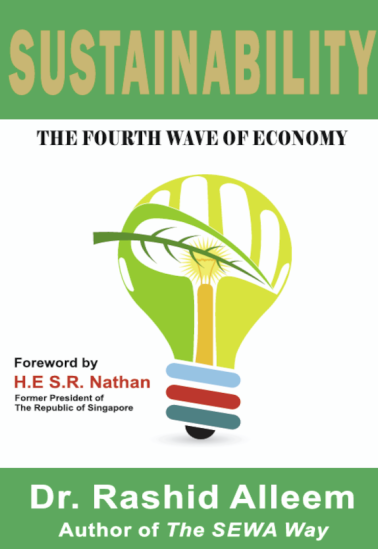
Sustainability is not an option—it is the fourth wave of human and economic progress.
In Sustainability – The Fourth Wave of Economy, Dr. Rashid Alleem explains how the global economy has moved through the agricultural, industrial, and information revolutions and is now entering a new era centered on sustainability.
The book presents a people-first approach that balances economic development with environmental responsibility, inclusive growth, cultural identity, ethical values, and long-term human well-being.
Sustainability • Socioeconomic Development • Thought Leadership
Building a fair, resilient, inclusive, and environmentally responsible future.
By Dr. Rashid Alleem
Dr. Rashid Alleem presents the idea that the global economy has undergone three significant waves—the agricultural revolution, industrial revolution, and information revolution—and is now entering the fourth wave: sustainability.
This fourth wave is characterized by the need to balance economic progress with environmental stewardship, inclusive development, ethical responsibility, and long-term human well-being.
Agriculture: The foundation of civilizations, although overexploitation eventually contributed to soil degradation.
Industrialization: Improved living standards but also created pollution, economic imbalance, and conflict.
Information Age: Transformed communication and technology while increasing inequality in many societies.
Sustainability: A shift toward environmentally conscious, inclusive, and people-first development.
The movement toward sustainability is driven by climate change, inequality, resource depletion, and the social consequences of development models that prioritize growth without considering people or the environment.
Meeting the needs of the present without compromising the ability of future generations to meet their own needs.
The book presents sustainability as a long-term responsibility requiring cooperation between governments, businesses, communities, and individuals.
Faith and Religion: An ethical foundation for responsible and sustainable values.
Social Sustainability: Uplifting marginalized communities and promoting equality.
Economic Sustainability: Inclusive growth that empowers citizens and communities.
Environmental Sustainability: Conservation, clean energy, and green infrastructure.
Cultural Sustainability: Preserving identity, traditions, and heritage as essential elements of long-term development.
Growth without inclusivity is both unsustainable and unjust. Economic progress must improve the lives of all people rather than benefit only a limited group.
The book discusses examples such as India’s demographic dividend and the United Arab Emirates’ vision for tourism-led economic development.
Dr. Alleem argues that many current economic systems are overly corporate-centered and often ignore the wider social and environmental costs of development.
Without people, there is no economy.
We cannot have growth if half the world lives on $2 a day.
Sustainability is not an option—it is our future.
Dr. Rashid Alleem urges governments, businesses, communities, and individuals to embrace sustainability not as a temporary trend, but as the fourth revolution of human progress.
It is a call to build a fair, resilient, balanced, and inclusive world where economic growth benefits both people and the planet.
| Title | Sustainability – The Fourth Wave of Economy |
|---|---|
| Author | Dr. Rashid Alleem |
| Published | 2014 |
| Genre | Sustainability, Socioeconomic Development, and Thought Leadership |