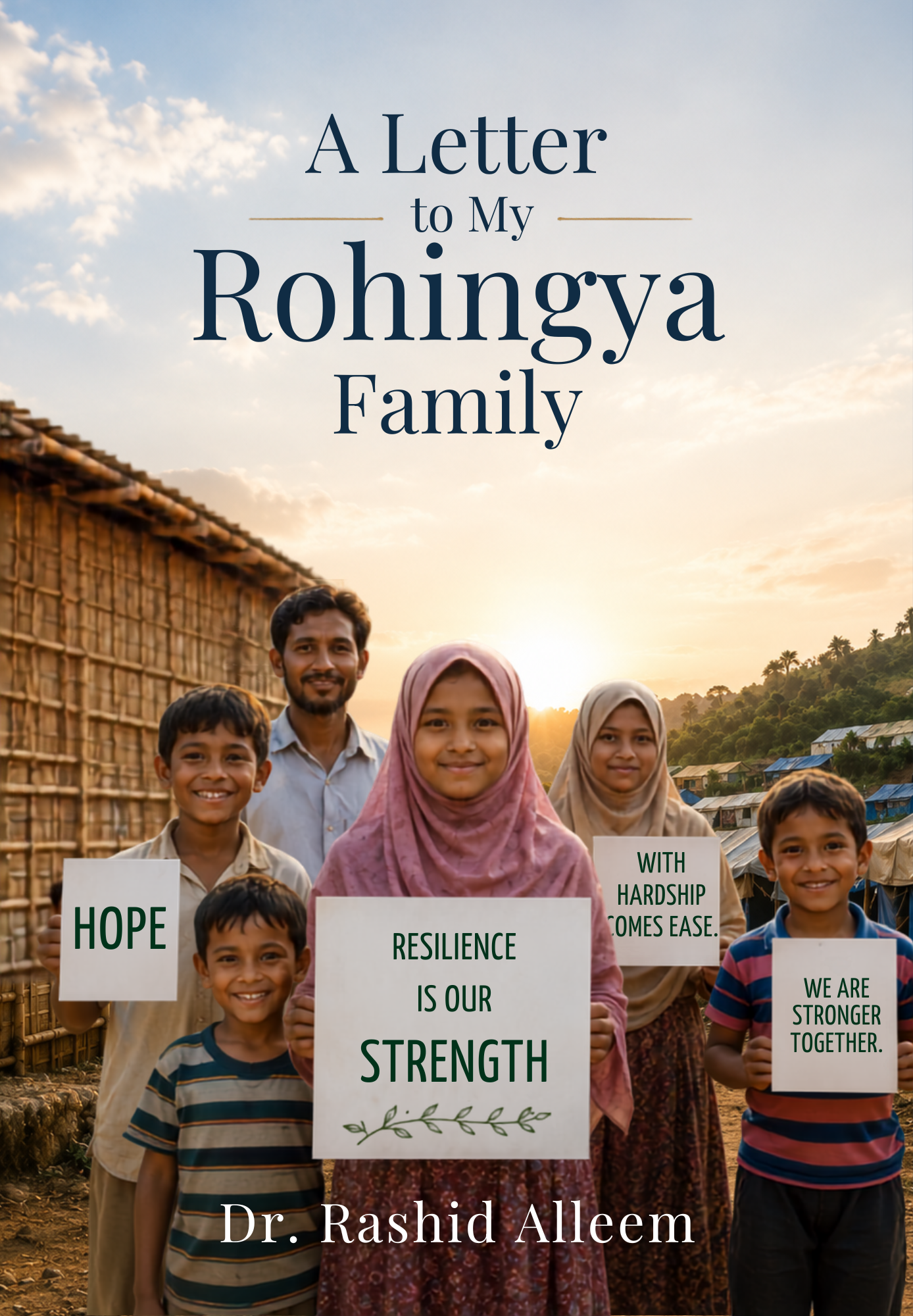
You are not forgotten. A personal tribute to resilience, faith, dignity, and the enduring strength of the human spirit.
In A Letter to My Rohingya Family, Dr. Rashid Alleem reflects on a promise made after his first visit to the Rohingya refugee camps twenty-five years ago: to speak for people whose voices are too often ignored.
This deeply humanitarian work explores survival, trauma, patience, gratitude, cultural identity, and hope while offering practical lessons on how individuals and communities preserve their dignity during prolonged hardship.
Humanitarianism • Resilience • Human Dignity
A personal tribute to unwavering resilience, spiritual strength, and the dignity that survives even the most difficult circumstances.
By Dr. Rashid Alleem
What does it mean to remember people whose suffering has continued for years beyond the world’s attention?
In A Letter to My Rohingya Family, Dr. Rashid Alleem reflects on a promise made after his first visit to the Rohingya refugee camps twenty-five years ago: to speak for those whose voices are frequently silenced by distance, indifference, and prolonged crisis.
This is not presented as a political argument. It is a humanitarian statement about faith, endurance, identity, compassion, and the strength of the human spirit in the face of displacement and hardship.
The book looks beyond statistics and reminds readers that every refugee camp is filled with individuals, families, memories, hopes, fears, and invisible wounds.
It seeks to preserve the humanity of those whose lives are often reduced to reports and numbers while offering reflections on how dignity, faith, and hope can endure when almost everything else has been taken away.
I left the camps physically, but in truth, part of my heart never left.
Understand the human experiences hidden behind refugee statistics.
Explore how faith and dignity can survive prolonged hardship.
Recognize the emotional wounds caused by displacement and uncertainty.
Learn practical principles for maintaining hope and inner strength.
Understand the importance of language, culture, memory, and belonging.
Respond to human suffering with compassion rather than indifference.
Behind the statistics associated with one of the world’s largest refugee settlements are more than numbers. There are human beings carrying memories, responsibilities, grief, faith, and hopes for a safer future.
The book acts as a hand of solidarity, offering comfort, recognition, and practical guidance for readers seeking to understand how the human heart continues when stability, home, and certainty have been lost.
Dignity can endure even in adversity. Patience is not a weakness but one of the greatest forms of strength.
The Crucible of the Camps: A direct reflection on the daily struggle for survival and the architecture of an undefeated life built through small acts of courage and dignity.
Healing the Invisible Wounds: Insight into trauma, anxiety, grief, and emotional pain that traditional relief reports may overlook.
The Unwavering Anchor: Reflections on Sabr, or active patience, and Shukr, or gratitude, as life-sustaining disciplines rather than abstract ideas.
The Power of Small Joys: How laughter, kindness, family connection, and moments of generosity demonstrate that the human spirit can remain open to goodness during suffering.
Preserving Identity: The importance of language, culture, faith, memory, and shared traditions as acts of resistance against erasure.
Practical Resilience: Actionable guidance for protecting inner strength, personal agency, emotional stability, and hope when the future remains uncertain.
A Letter to My Rohingya Family combines personal reflection, humanitarian testimony, spiritual insight, and practical lessons on resilience.
This manifesto is written for readers who refuse to allow the length of a crisis to make human suffering appear normal or unimportant.
It reminds us that history may be slow to deliver justice, but compassion, solidarity, and responsible action should not be delayed.
The book encourages individuals, leaders, humanitarian organizations, and communities to recognize that lasting support begins by seeing displaced people not merely as victims, but as human beings with agency, identity, courage, and aspirations.
Dr. Rashid Alleem’s connection to the Rohingya community began with a personal encounter that remained with him long after leaving the camps.
This book represents the continuation of that promise: to remember, bear witness, and use the written word to affirm that those enduring displacement have not been forgotten.
You are not forgotten. Your strength, dignity, and humanity continue to speak even when the world remains silent.
Dr. Rashid Alleem is an internationally recognized author, humanitarian advocate, and leader whose work explores resilience, sustainable development, compassion, ethical responsibility, and human dignity.
Through personal reflection, leadership experience, and humanitarian engagement, he seeks to preserve overlooked stories and encourage individuals and institutions to respond to suffering with understanding and meaningful action.
Secure your hardcover copy of A Letter to My Rohingya Family and join Dr. Rashid Alleem in honoring a twenty-five-year promise to remember, bear witness, and affirm the dignity of people whose strength continues through extraordinary hardship.
| Title | A Letter to My Rohingya Family |
|---|---|
| Author | Dr. Rashid Alleem |
| Format | Hardcover |
| Print Length | 86 pages |
| Language | English |
| Publisher | Dr. Rashid Alleem |
| Publication Date | 04 June 2026 |
| Dimensions | 13.0 × 19.0 cm |