

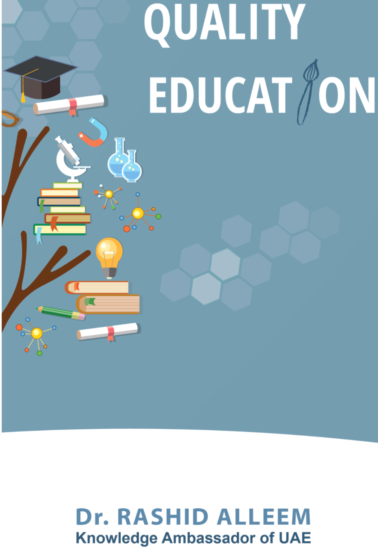
Every child deserves more than access to school—they deserve meaningful, inclusive, and high-quality learning.
In Quality Education, Dr. Rashid Alleem presents education as a fundamental human right and a powerful tool for unlocking individual potential, strengthening communities, and supporting sustainable development.
Through global case studies, educational frameworks, and inspiring initiatives, the book explains how learner-centered education can create equity, empowerment, creativity, and lifelong opportunity.
Education • Inclusion • Human Development
A global call for learner-centered education that develops human potential, strengthens communities, and creates lasting opportunity.
By Dr. Rashid Alleem
Dr. Rashid Alleem champions education as a fundamental human right and one of the strongest tools for unlocking human potential.
This book explores how quality education can become a catalyst for personal fulfillment, social progress, economic empowerment, and sustainable development.
It emphasizes that access to schooling alone is not enough. Education must be inclusive, effective, human-centered, and capable of preparing learners for meaningful lives.
Quality Education examines how schools, universities, governments, communities, and educational organizations can improve learning outcomes by focusing on quality rather than enrollment numbers alone.
The book combines global examples, institutional standards, community initiatives, and human stories to demonstrate how education can promote equity, creativity, confidence, and lifelong learning.
Education as a Human Right: Quality learning is a basic public service and a foundation for equity, empowerment, and social progress.
Innovative Education Systems: Successful systems are built on trust, inclusion, equity, teacher empowerment, and learner well-being.
ISO 21001: Educational organizations can improve effectiveness, credibility, and learner satisfaction through structured management systems.
Capacity Building: Teacher development, gender equality, community participation, and institutional improvement are essential for lasting impact.
Finland: A system with limited standardized testing, high teacher autonomy, learner well-being, and whole-child development.
Shanghai: Education reforms that move learning beyond memorization toward application, reasoning, and critical thinking.
Singapore: A centralized, data-informed system with strong teacher development and a commitment to educational excellence.
Switzerland: High-quality multilingual public education supported by strong local governance.
ISO 21001: A global standard for Educational Organization Management Systems.
Holistic Learning: Supporting cognitive, emotional, social, and personal development.
Capacity Building: Equipping educators and institutions to adapt, improve, and innovate.
Inclusive Access: Supporting marginalized communities, particularly girls and students in rural areas.
Lifelong Learning: Extending education beyond school through adult, community-based, and professional learning.
Education must go beyond classrooms and examination scores.
Every child deserves not only schooling, but quality learning that prepares them for a meaningful life.
The book calls on leaders, educators, institutions, families, and communities to treat education as a human-centered journey of growth, creativity, inclusion, and social impact.
Quality Education is more than a study of schools and institutions. It is a global call to provide every learner with an inclusive, empowering, and meaningful educational experience.
Discover how stronger teachers, learner-centered institutions, innovative systems, and community participation can transform education and create a more equitable future.
| Title | Quality Education |
|---|---|
| Author | Dr. Rashid Alleem |
| Published | 2018 |
| Category | Personal Development |
| Focus | Quality learning, inclusive education, teacher development, educational management, and sustainable development |